The Paperwork Miracle That Gave a Prairie Town Its Own Underwater Kingdom
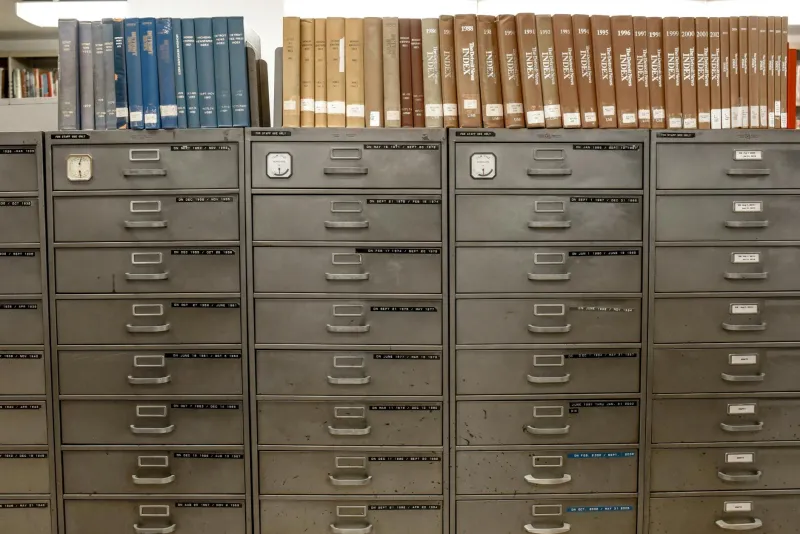
When Filing Cabinets Hold Secrets Worth Millions
Imagine walking into city hall to pay your water bill and discovering that your sleepy Midwestern town technically owns a chunk of the ocean floor larger than Manhattan. That's exactly what happened in 1987 when a curious clerk in Millfield, Nebraska was digitizing old municipal records and stumbled across the most bizarre real estate deed in American history.
Tucked between property transfers for grain silos and Main Street storefronts was official documentation declaring that Millfield — population 847, located 900 miles from the nearest ocean — held legal title to 47 square miles of Pacific Ocean floor, roughly 200 miles southwest of the California coast.
The Perfect Storm of Government Paperwork
The story begins in 1934, during the height of the Great Depression. President Franklin D. Roosevelt's administration was launching ambitious programs to put Americans back to work, including the obscure Maritime Seabed Survey Initiative. This forgotten New Deal program aimed to map and catalog underwater territories that could potentially be developed for mining or fishing.
Here's where things get wonderfully weird.
The program required each participating state to designate "administrative municipalities" to handle the paperwork for seabed parcels. Nebraska, eager for any federal dollars, volunteered enthusiastically. A harried clerk in Lincoln randomly selected Millfield from a hat containing slips of paper with every incorporated town in the state.
Meanwhile, in Washington D.C., another clerk was matching seabed coordinates with administrative towns using what can only be described as the world's most consequential game of bureaucratic bingo. Through a series of clerical errors, mathematical mistakes, and pure cosmic coincidence, Millfield got assigned Parcel 247-B: a mineral-rich section of ocean floor that would later be discovered to contain significant deposits of manganese and rare earth elements.
The Documents That Nobody Read
The official transfer papers arrived in Millfield on a Tuesday in March 1935. Mayor Harold Wickham, a wheat farmer who viewed his municipal duties as a part-time nuisance, signed the documents without reading them. He later told his wife he assumed they were "more Roosevelt nonsense about soil conservation."
The papers were filed in the town hall basement, where they sat undisturbed through the Dust Bowl, World War II, the Korean War, the Space Race, Watergate, disco, and the Reagan administration.
For 52 years, Millfield unknowingly held legal title to underwater real estate worth an estimated $47 million in today's dollars.
The Discovery That Changed Everything
Mary Ellen Peterson was three weeks into her summer job digitizing municipal records when she opened the manila folder that would make legal history. The 19-year-old college student initially thought someone was playing an elaborate prank.
"I called my supervisor over and said, 'Either this is fake, or we own part of the ocean,'" Peterson later recalled. "He looked at it for about thirty seconds and said, 'Well, the seal looks real.'"
The supervisor, City Clerk Robert Hayes, spent the next week making increasingly frantic phone calls to state and federal agencies. Each conversation followed the same pattern: initial laughter, followed by silence, followed by requests to fax the documents immediately.
When the Lawyers Arrived
Within a month, Millfield had more lawyers than residents. Maritime law experts, mineral rights attorneys, and federal bureaucrats descended on the town like a legal locust swarm. The local diner ran out of coffee twice in one week — a crisis that hadn't occurred since the blizzard of 1978.
The consensus among legal experts was both hilarious and terrifying: the documents were absolutely legitimate. Through a combination of properly executed federal authority, valid state cooperation, and ironclad municipal signatures, Millfield had indeed become the legal owner of a substantial piece of the Pacific Ocean floor.
The Government's Awkward Problem
Federal officials found themselves in an unprecedented pickle. How do you explain to Congress that a Nebraska farming town accidentally acquired underwater mineral rights worth tens of millions of dollars? How do you politely ask for them back?
The situation became even more complicated when marine biologists discovered that Parcel 247-B contained several previously unknown species of deep-sea creatures, potentially making it scientifically invaluable.
The Resolution Nobody Saw Coming
After eighteen months of legal wrangling, Millfield made a decision that surprised everyone. Rather than fight for their accidental underwater empire, the town council voted unanimously to donate their ocean floor parcel to the National Marine Sanctuary system.
Mayor Janet Kowalski explained the decision simply: "We're farmers, not fishermen. What the heck would we do with the bottom of the ocean?"
The Legacy of America's Strangest Real Estate Deal
Today, a small plaque in Millfield's town hall commemorates their brief reign as landlocked ocean barons. The former Parcel 247-B is now part of the Pacific Deep Sea Preserve, protecting both its mineral wealth and unique ecosystem.
Mary Ellen Peterson went on to become a maritime lawyer specializing in underwater property rights. She keeps a framed copy of the original deed in her office — proof that sometimes the most incredible stories are hidden in the most boring filing cabinets.
The moral of the story? Always read your paperwork. You never know when you might accidentally own part of the ocean.