Special Delivery, Terminal Velocity: The Time Uncle Sam Fired the Mail Out of a Missile
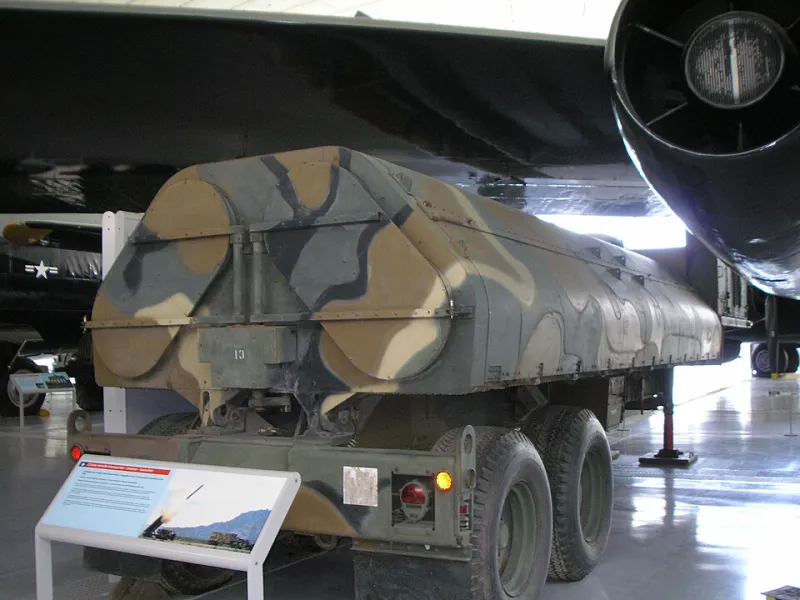
Photo: Nick Dowling, CC BY-SA 3.0, via Wikimedia Commons
Every era gets the technology it deserves, and in 1959 America deserved a country that looked at a nuclear-capable cruise missile and thought, you know what else would fit in there? Birthday cards.
That's not a joke. That's policy history.
The Postmaster General Has an Idea
Arthur Summerfield ran the U.S. Post Office under President Eisenhower, and he was not a modest man about the future. He'd already championed ZIP codes' predecessors, mechanized sorting, and every whiff of modernization drifting through the Jet Age. So when the Navy offered to demonstrate that a Regulus I cruise missile — a machine designed to deliver a warhead thousands of miles — could instead deliver correspondence, Summerfield didn't blink.
He leaned in. Hard.
On June 8, 1959, the submarine USS Barbero, parked off the Atlantic coast, loaded a Regulus missile with two official red-and-blue postal containers holding about 3,000 pieces of mail. The mail was real: letters addressed to Postmaster Summerfield, the Vice President, government agencies, and ordinary citizens who'd been invited to send something aboard.
The missile launched, cruised roughly 100 miles, and parachuted down at Naval Air Station Mayport in Jacksonville, Florida. Total flight time: about 22 minutes. Summerfield, standing on the tarmac, declared the event a triumph and announced that before the century was out, missile mail would carry letters across the country and around the globe.
One of those 3,000 letters made it all the way through — a genuine piece of mail that traveled by submarine, by cruise missile, and by postman, and was delivered and kept. Collectors would later pay staggering sums for fragments of the experiment; the surviving flown covers are holy grails of postal history.
The Bureaucracy Actually Debated This
Here's the part that makes the story truly strange rather than merely retro: the follow-up wasn't laughter. It was meetings.
The Post Office and the Defense Department genuinely studied scaling missile mail up. Cost analyses were run. The Navy explored whether Regulus deliveries could serve remote outposts. Summerfield gave speeches about a future where a letter posted in New York at breakfast arrived in Los Angeles by lunch, courtesy of rocketry. Postal officials drafted plans. Engineers didn't laugh them out of the room, because in 1959, rockets seemed like the answer to everything — houses, cars, hotels, and apparently correspondence.
The math, eventually, did the laughing. A single missile launch cost a fortune to deliver a few thousand letters, which works out to roughly a hundred dollars per letter in modern money — before you factor in that every flight required a Navy submarine, a trained crew, and the tolerance of an American public for mail that could theoretically double as a weapons platform. The program was quietly shelved after exactly one flight.
Why It Almost Makes Sense
Strip away the absurdity and the logic is almost airtight — for 1959. Missiles were the fastest objects humans had ever built. Mail was slow. Speed plus mail equals progress. The failure wasn't imagination; it was that the Post Office priced the future before the future got cheap. (SpaceX's modern cargo rockets, it's worth noting, have made people mutter about missile mail again. The idea never dies. It just waits for the math.)
Today, the Barbero's flight survives as a footnote with excellent trivia value: the only time the United States officially delivered mail by missile, complete with genuine postal cancellation marks reading "Missile Mail."
If you ever find one of those covers in a shoebox at an estate sale, buy it. It's a letter that outran the Cold War and landed gently on a Florida tarmac — the fastest mail delivery in American history, and likely the only one where the mail arrived before anyone could read it.