One Soviet Officer Said No — and That's Probably Why You're Alive
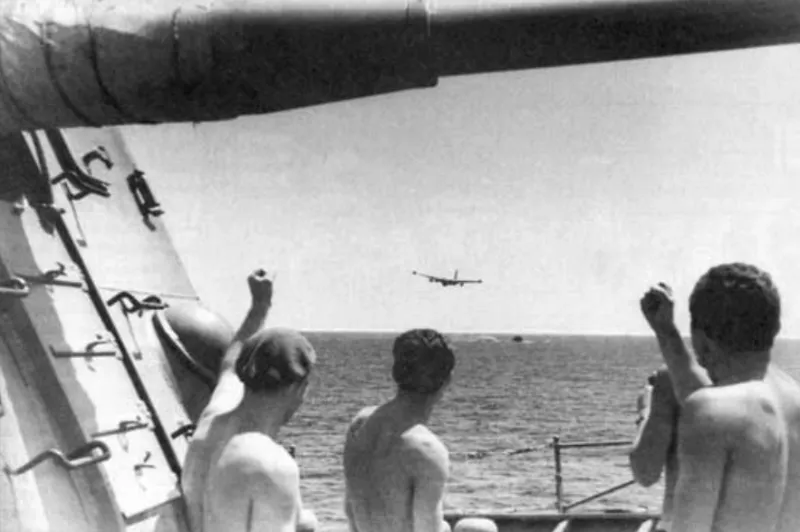
Photo: Lyle J. Goldstein; Yuri M. Zhukov, Naval War College’s Center for Naval Warfare Studies. Cushing Road, Newport, RI 02841., Public domain, via Wikimedia Commons
Somewhere in the Atlantic Ocean, in October 1962, a Soviet submarine sat at depth with its crew near the breaking point. The air was going bad. The temperature inside the hull had climbed past 100 degrees Fahrenheit. They hadn't been able to surface for days. American destroyers were dropping depth charges above them — not to sink the sub, but to force it to surface, though the crew had no way of knowing that.
The captain believed war had already started.
On board was a nuclear-armed torpedo. Under Soviet naval protocol, launching it required the agreement of three senior officers. Two of them said yes.
The third said no.
His name was Vasili Arkhipov. You've almost certainly never heard of it. That's the part of this story that should genuinely unsettle you.
The Submarine Nobody Was Supposed to Know About
In October 1962, as the world watched the standoff between Kennedy and Khrushchev over Soviet missiles in Cuba, four Soviet submarines were quietly operating in the Atlantic. Their presence wasn't publicly known. Their orders weren't entirely clear, even to their own crews. And their communications with Moscow had been effectively severed by American naval activity.
B-59 was one of those submarines. Its captain, Valentin Savitsky, was operating on fragmentary information, deteriorating conditions, and the reasonable assumption — given the depth charges rattling his hull — that a war had begun above him.
The submarine carried a T-5 nuclear torpedo. Its yield was roughly equivalent to the bomb dropped on Hiroshima. The standing orders, as the crew understood them, permitted its use if certain conditions were met — and to Captain Savitsky, those conditions appeared to have been met.
He wanted to launch.
The Protocol That Stood Between the World and Catastrophe
Here's the structural detail that made everything hinge on one person's decision.
Soviet submarines of this class carried a political officer — a zampolit — whose agreement was required for any nuclear weapons release, alongside the captain. That was two. But B-59 also happened to be carrying a senior officer from the submarine flotilla's command staff: Vasili Arkhipov, who held the same rank as Captain Savitsky and whose authorization was also required.
Three men. Three keys, figuratively speaking. Two said yes.
Arkhipov said no.
The accounts of what happened in that conversation have been reconstructed from Soviet records and the later testimony of surviving crew members, and they are not comfortable reading. Savitsky was not a man who took well to being overruled. The argument was loud. The conditions inside the submarine — the heat, the CO2 buildup, the exhaustion, the fear — were not conditions designed to produce calm deliberation.
Arkhipov held his position. He argued that they couldn't confirm war had actually broken out. That the depth charges, while terrifying, were a signaling tactic rather than an attack. That surfacing and making contact was the right call before any irreversible action was taken.
Savitsky relented. B-59 surfaced. The Americans were surprised. Nobody fired. The submarine eventually returned to the Soviet Union.
The Part That Was Classified for Decades
This is where the story takes a turn that's almost more disturbing than the close call itself.
For roughly forty years, almost nobody outside a small circle of Soviet military and intelligence officials knew this had happened. The Cuban Missile Crisis was extensively documented, analyzed, and written about — it generated an entire cottage industry of political science and historical scholarship. But the near-launch on B-59 wasn't part of that conversation, because the Soviet Union didn't disclose it and the Americans didn't know the details.
The story began to emerge publicly in 2002, at a conference in Havana marking the 40th anniversary of the crisis. American and Russian participants, including former defense secretary Robert McNamara, heard the account for the first time. McNamara's reported reaction was something close to horror. He later said that the incident illustrated how close the world had come to nuclear war through mechanisms that neither side fully understood or controlled at the time.
Arkhipov himself died in 1998 — four years before the story became public. He never received formal recognition for what he'd done. His wife gave interviews years later describing a man who rarely talked about the incident, who didn't consider himself a hero, and who seemed genuinely puzzled that anyone would make a fuss about a decision that seemed, to him, obviously correct.
The Uncomfortable Arithmetic of Close Calls
Here is the thing about this story that historians and nuclear policy researchers find most significant, and most troubling.
The near-launch on B-59 wasn't the result of a system failure. It was the result of a system working as designed. The submarine had nuclear weapons. It had orders that authorized their use under certain conditions. It had a captain who believed those conditions had been met. The only thing that prevented a launch was a procedural requirement that happened to put one specific person in a position to object — and the fact that that person had the temperament and the certainty to use his veto when it counted.
Remove Arkhipov from that submarine. Put a different officer in his role, one who agreed with Savitsky. Change the protocol so that only two authorizations were required instead of three. Any of those variables, and October 1962 ends differently.
The world didn't not end because of careful planning or robust safeguards or the wisdom of superpower leadership. It didn't end because one exhausted man on a sweltering submarine, surrounded by depth charges and bad air and a captain who outranked him in everything but the one authority that mattered, said two letters.
No.
You're welcome.