When a Nevada Mining Town Became '40' and the Post Office Said 'Absolutely Not'

The Number That Broke the Mail
Imagine living in a place so committed to being different that it literally renamed itself after a number — only to discover that the federal government had strong opinions about mathematical municipalities. That's exactly what happened to a small Nevada mining community in the 1950s, when civic pride collided head-on with postal policy in one of the most absurd bureaucratic standoffs in American history.
How a Mining Claim Became Municipal Madness
It started as a publicity stunt with serious intentions. The residents of a tiny Nevada settlement near the California border had been struggling with their town's identity for years. Originally called Searchlight Junction, then briefly Cottonwood Springs, the community couldn't seem to settle on a name that stuck. Local mining operations dominated the economy, and one particularly promising claim was designated as "Claim 40" on geological survey maps.
 Photo: Searchlight Junction, via avstumpfl.com
In 1953, during a particularly optimistic period for the local mines, the town's 47 registered voters decided to embrace their mining heritage in the most literal way possible. They held a formal vote and officially changed their municipal name to "40" — making it the first and only American town to be named after a pure number.
The decision seemed brilliant at first. Local newspapers picked up the story, curious tourists started showing up, and the town's single diner began selling "Forty Burgers" to capitalize on the novelty. For a few months, being America's only numerically-named town felt like a stroke of marketing genius.
When the Post Office Said No
Then the mail stopped coming.
The U.S. Postal Service, it turned out, had a regulation buried deep in their administrative code that prohibited numeric place names. The rule had been established decades earlier to prevent confusion with zip codes, postal routes, and sorting systems that relied on numerical designations. When postal workers in Reno tried to process mail addressed to "40, Nevada," their sorting machines literally couldn't compute it.
Postal supervisor Margaret Henley later recalled the chaos: "Our machines kept spitting out anything addressed to '40' because the system thought it was an incomplete zip code. We had mail trucks driving in circles because drivers couldn't find a town that their route sheets listed as a number."
The Postal Service offered a compromise: the town could keep its legal name as "40," but all mail would have to be addressed to the neighboring community of Searchlight, Nevada, with a special notation for "40 residents." The townspeople rejected this solution, arguing that it defeated the entire purpose of having a unique municipal identity.
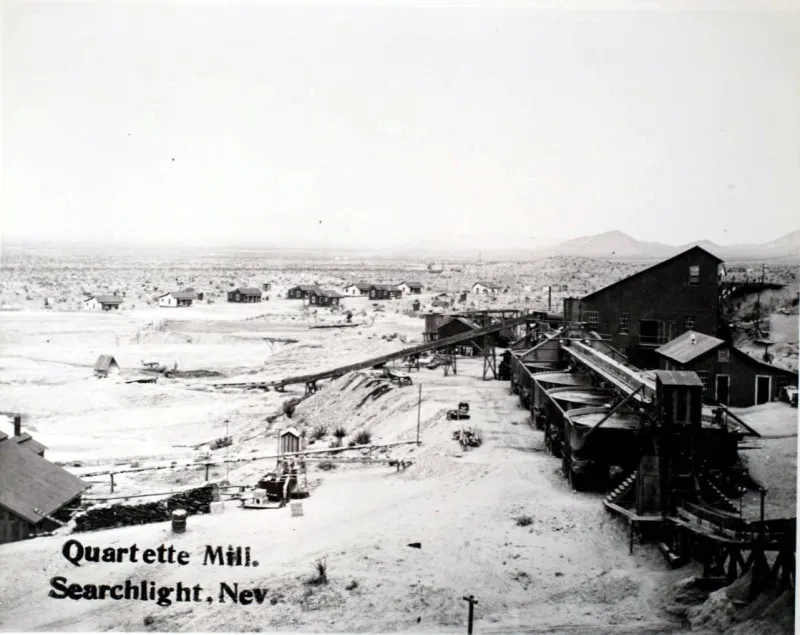 Photo: Searchlight, Nevada, via i0.wp.com
The Great Postal Standoff
What followed was nearly a decade of bureaucratic warfare that would have been hilarious if it hadn't been so frustrating for the people actually trying to receive their mail. Residents had to drive 23 miles to Searchlight to collect packages, letters, and even their Social Security checks. Local businesses couldn't receive shipments directly. The town's only doctor had to maintain a separate mailing address in Las Vegas just to receive medical supplies.
Meanwhile, the legal battle escalated through federal courts. The town hired a Las Vegas attorney who argued that municipal naming rights were a matter of local sovereignty protected by the Tenth Amendment. The Postal Service countered that their authority to regulate mail delivery superseded local naming preferences, especially when those names interfered with federal postal operations.
The case attracted national attention, with newspapers across the country covering the ongoing saga of "the town that couldn't get mail." Late-night television hosts made jokes about the "40-year-old town that couldn't receive birthday cards." Tourism actually increased as curious Americans drove to Nevada just to see the place that had broken the postal system.
The Compromise That Changed Everything
The standoff finally ended in 1962 with a compromise that satisfied no one but worked for everyone. The town would officially become "Forty, Nevada" — spelling out the number to comply with postal regulations while maintaining its numerical identity. Residents could legally say they lived in "40" for local purposes, but all federal correspondence would use the written form.
This solution created a legal precedent that still governs American place naming today. The "Forty Rule," as postal workers call it, prohibits any U.S. community from incorporating with a purely numeric name. Cities can include numbers (like "Seven Hills, Nevada" or "Thousand Oaks, California"), but they must be part of a larger word-based name.
The Legacy of America's Most Mathematical Municipality
Today, Forty, Nevada exists as a testament to the unexpected complexity of American bureaucracy. The town's population has dwindled to fewer than a dozen permanent residents, but it maintains its unique place in postal history. The original "40" sign still stands at the town limits, now accompanied by a smaller sign explaining the postal compromise.
More importantly, the case established crucial legal boundaries between local self-determination and federal regulatory authority. Municipal law textbooks still reference the "Forty Decision" when discussing the limits of local naming rights. The case has been cited in dozens of subsequent disputes over unconventional place names, from a Texas community that wanted to call itself "@" to a Colorado town that briefly considered becoming "404 Not Found."
The story of Forty, Nevada proves that even the most mundane aspects of American life — like how we name our towns and deliver our mail — can become battlegrounds for larger questions about identity, authority, and the surprising ways that federal bureaucracy shapes daily life. Sometimes the most ordinary government functions create the most extraordinary conflicts, and a simple publicity stunt can accidentally rewrite the rules for an entire nation.
In the end, Forty, Nevada got exactly what it wanted: a place in American history that no other town can claim. It just took a decade of undelivered mail to get there.