He Left Earth for Almost a Year and Came Back Younger Than His Own Twin

Photo: NASA/Don Pettit, Public domain, via Wikimedia Commons
Two Men, One Birthday, and a Problem Einstein Predicted
Mark and Scott Kelly were born the same day, within minutes of each other, in West Orange, New Jersey. They grew up in the same house, went to the same schools, joined the same branch of the military, and both eventually became NASA astronauts. For the first several decades of their lives, they were, by every biological and legal measure, the same age.
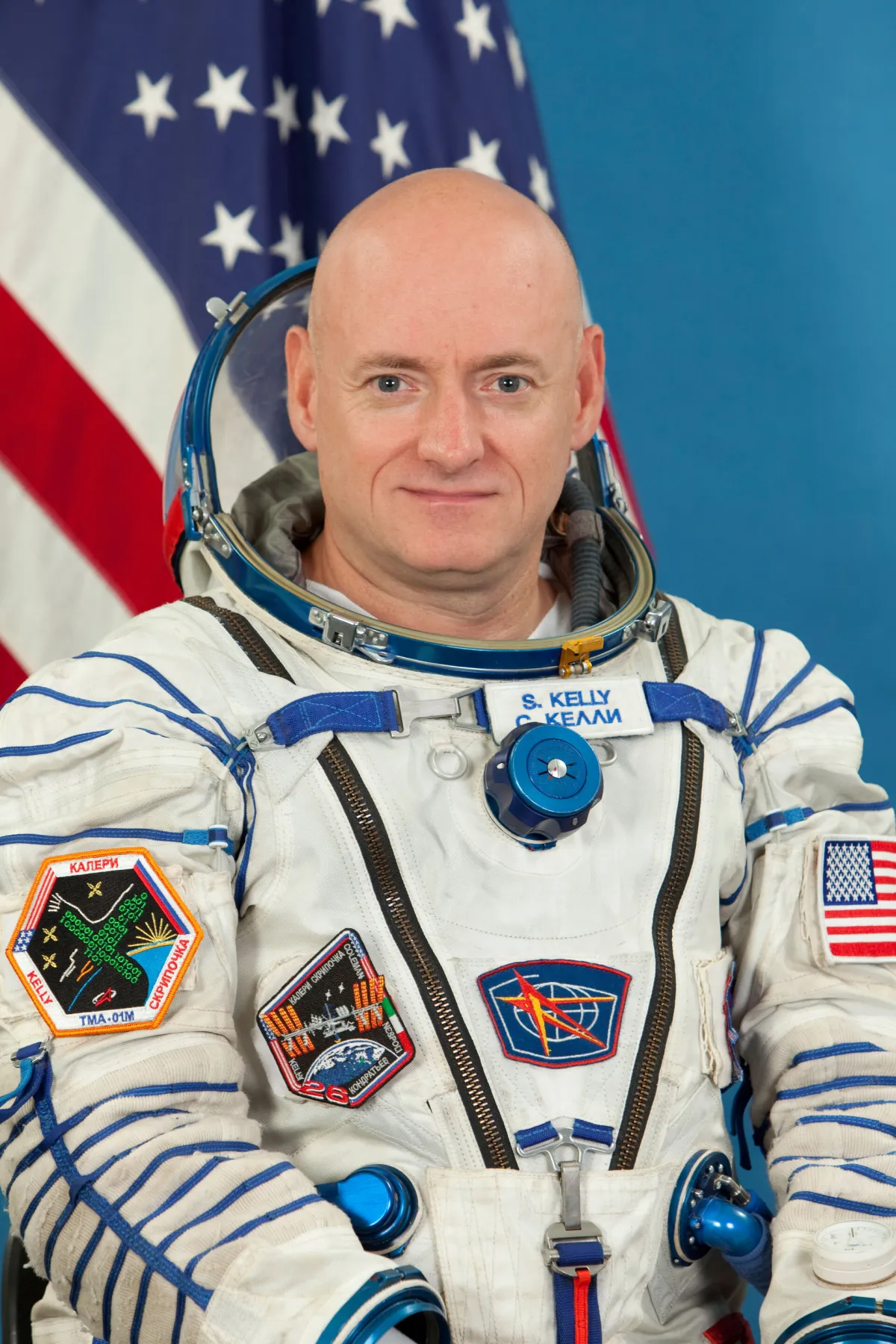 Photo: Scott Kelly, via www.esa.int
Then Scott went to space for nearly a year, and physics broke that assumption permanently.
When Scott Kelly returned from the International Space Station in March 2016, after 340 consecutive days in orbit, NASA scientists confirmed something that had been theoretically predicted for a century but never practically demonstrated in a human being quite so clearly: Scott had aged measurably less than his brother. Not metaphorically. Not approximately. Measurably, documentably, scientifically less.
By a margin of roughly 8.6 milliseconds, Scott Kelly is now younger than his identical twin.
That's not a rounding error. That's physics working exactly as advertised.
Einstein Was Right, and That Turned Out to Be a Headache
Albert Einstein's theory of special relativity, published in 1905, predicted that time passes more slowly for objects moving at high speeds relative to a stationary observer. The faster you move, the slower your clock ticks compared to someone standing still. This phenomenon — called time dilation — has been confirmed in laboratory settings, in particle accelerators, and in the GPS satellites that your phone relies on every day (which have to account for relativistic time differences to give you accurate directions).
 Photo: Albert Einstein, via cdn.pixabay.com
But Scott Kelly's case was different. This wasn't a cesium atom in a lab or a signal from a satellite. This was a human being — a specific, named, legally documented American citizen — who had physically aged at a different rate than his genetic duplicate.
NASA's Twin Study, which used Mark as a ground-based control subject while Scott orbited overhead, was designed to measure the biological effects of long-duration spaceflight. What it produced was something far stranger than anyone had fully anticipated: a real-world demonstration that two people born at the same moment can, given the right circumstances, stop being the same age.
The Scientists Who Had to Ask Questions Nobody Had Written Down
The biological findings from the Twin Study were remarkable on their own. Scott's telomeres — the protective caps on the ends of chromosomes, often used as a marker of biological aging — actually lengthened during his time in space, which was the opposite of what researchers expected. His gene expression shifted. His gut microbiome changed. His cognitive performance showed measurable differences from his brother's.
But it was the time dilation finding that sent a different group of people into a quiet tailspin: the legal scholars.
Because here's the thing nobody had thought to write a law about. In the United States, your legal age is determined by your date of birth. It's a fixed point. You turn 21 on a specific date, you become eligible for Social Security at a specific age, your driver's license expires on a specific birthday. The entire architecture of American legal identity assumes that time passes at the same rate for everyone.
Scott Kelly's case proved that assumption is not, strictly speaking, true.
Now, 8.6 milliseconds is not going to change when Scott Kelly can collect his pension. Nobody is seriously arguing that he should get a new birth certificate. But the questions the case raised were genuine enough that NASA convened discussions with bioethicists and legal theorists about what the implications might be as space travel becomes longer, more common, and more commercially available.
What Happens When You Age Slower Than the Law Expects?
Imagine a future where commercial passengers spend six months traveling to Mars at speeds that produce meaningful time dilation. They depart Earth at age 40. By the time they return, they've biologically aged less than their relatives back home — not by milliseconds, but by hours, days, potentially weeks.
At what age do they retire? When do their contracts expire? If two people signed a legal agreement before departure, and one of them is now measurably younger than the other due to relativistic effects, does the agreement still hold in the terms both parties understood?
These questions sound like science fiction. They are not. They are the direct logical extension of what Scott and Mark Kelly demonstrated, and the scientific community knows it.
 Photo: Mark Kelly, via www.offthepress.com
Several papers published in the years following the Twin Study explicitly flagged the legal and ethical dimensions of relativistic aging as an unresolved problem that humanity will need to address before deep space travel becomes routine. As one NASA researcher put it in a 2017 interview, the Kelly twins didn't just give us data about spaceflight — they gave us a preview of questions we don't have answers for yet.
The Brothers Who Broke the Calendar
Mark and Scott Kelly have both spoken publicly about the Twin Study with characteristic astronaut practicality — they find it interesting, they're glad it contributed to science, and they're not losing sleep over 8.6 milliseconds.
But the rest of us probably should sit with it for a moment.
Two men. Same parents. Same birthday. Same DNA. One of them went very fast for a very long time, and now they are not the same age. The universe didn't care about their birth certificates. It just did the math.
Einstein published the equations that predicted this outcome in 1905. It took until 2016 for two brothers from New Jersey to prove he was right in a way that anyone could understand.
The older twin is the one who stayed home. The younger one has been to space six times.
You genuinely cannot make this up.