When a Broke Washington Town Printed Money on Wood — and It Actually Worked
Picture a small Pacific Northwest logging town in the winter of 1931. The Great Depression has been grinding for two years. Unemployment is climbing. And then, on top of everything else, the Citizens Bank of Tenino, Washington, locks its doors and doesn't reopen. Every dollar the town's 1,300 residents had on deposit vanishes into the fog of a federal receivership process that could take years to resolve.
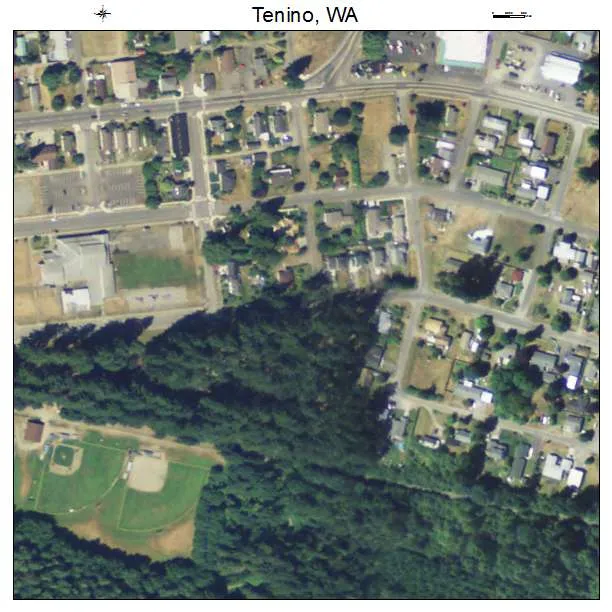 Photo: Tenino, Washington, via www.landsat.com
No bank. No cash. No obvious way to buy groceries, pay rent, or keep a business running.
The Tenino Chamber of Commerce looked at this situation and made a decision that, on paper, sounds completely unhinged: they would print their own money. On wood.
The Most Pacific Northwest Solution Possible
The choice of material wasn't random. Tenino was logging country, and thin sheets of spruce and cedar were locally abundant and cheap to produce. The Chamber commissioned the production of small rectangular wafers — roughly the size of a playing card — cut from spruce wood and printed with denominations of 25 cents, 50 cents, and one dollar.
The currency was officially called Tenino Wooden Money, which is a name that deserves some respect for its total lack of pretension.
Local businesses agreed to accept it. The Chamber issued it as scrip — essentially a community-backed IOU — to residents who needed to participate in the local economy while waiting for the federal receivership to release their frozen deposits. The wooden dollars couldn't be spent outside Tenino, which turned out to be a feature rather than a bug.
Why It Worked When It Shouldn't Have
Conventional economic wisdom suggests that currency only functions if people trust the authority backing it. The U.S. dollar works because the federal government guarantees it. Tenino's wooden money was backed by exactly nothing except a handshake agreement between the local Chamber of Commerce and the town's shopkeepers.
And yet it circulated. Businesses accepted it. Residents used it. The local economy kept moving.
The reason, economists have since argued, comes down to a principle that Depression-era policymakers were actively ignoring at the national level: velocity of money. The wooden scrip couldn't leave Tenino. It couldn't be hoarded in a distant bank or pulled out of circulation by nervous investors. Every wooden dollar that entered the local economy had to keep moving through it, because there was nowhere else for it to go.
This meant that a single wooden dollar could generate far more local economic activity than a single federal dollar, which might sit in a mattress or disappear into a savings account. The forced locality of the currency created a closed loop that kept Tenino's economy breathing while much of the country was suffocating.
The Rest of the Country Was Watching
Tenino wasn't the only community to experiment with Depression-era scrip — similar schemes popped up across the country between 1931 and 1934 — but it became one of the most documented and celebrated examples, partly because wooden money was so visually striking and partly because it worked so cleanly.
Newsreels covered it. Newspapers ran features. Tourists started showing up to buy wooden dollars as souvenirs, which created the somewhat surreal situation of outsiders injecting real federal currency into Tenino in exchange for the town's novelty scrip. The wooden money was becoming a small export industry.
The federal government eventually took notice of the scrip phenomenon nationwide. In 1933, President Roosevelt's administration moved to regulate and then phase out local currency experiments as part of the broader New Deal financial restructuring. The argument was that a patchwork of local currencies undermined national monetary policy. Critics pointed out that national monetary policy had just produced the worst economic collapse in American history, but that debate was above Tenino's pay grade.
 Photo: President Roosevelt, via c8.alamy.com
What Happened to the Wooden Dollars
When the Citizens Bank receivership was finally resolved and depositors began recovering their funds, Tenino's wooden money was retired. The experiment lasted roughly two years — long enough to demonstrate something real, short enough that most of the country forgot it happened.
The wooden dollars themselves didn't disappear. Because they were durable, distinctive, and carried a genuine piece of Depression-era history, they survived in drawers and boxes and collections across the Pacific Northwest. Today, original Tenino wooden dollars sell at auction for anywhere from $20 to over $200 apiece, depending on condition and denomination — a return on face value that would make any investment banker envious.
Tenino itself still celebrates the story. The town has periodically reissued commemorative wooden currency, most recently during the COVID-19 pandemic in 2020, when the city printed wooden dollars to distribute as direct aid to residents affected by the economic shutdown. The program worked well enough that it generated national coverage all over again.
The Part That Should Make You Think
Here's the thing about Tenino's wooden money that gets under your skin if you sit with it long enough. The town didn't have any particular economic expertise. They weren't running a monetary policy experiment. They were just desperate and creative and willing to try something that sounded absurd.
And in their desperation, they stumbled onto a functional demonstration of economic principles — local currency, velocity of money, community wealth circulation — that mainstream economists were still arguing about in academic journals decades later.
Sometimes the most rigorous experiments aren't the ones designed in universities. Sometimes they're the ones invented by a logging town that ran out of options on a cold winter morning in 1931.