A Senator Sued the Almighty. The Judge Had to Write a Real Ruling.

Let's be honest: most people, when frustrated with the state of the world, might shake their fist at the sky and move on. Nebraska State Senator Ernie Chambers did something considerably more formal. In September 2007, he walked into the Douglas County District Court in Omaha and filed a lawsuit against God.
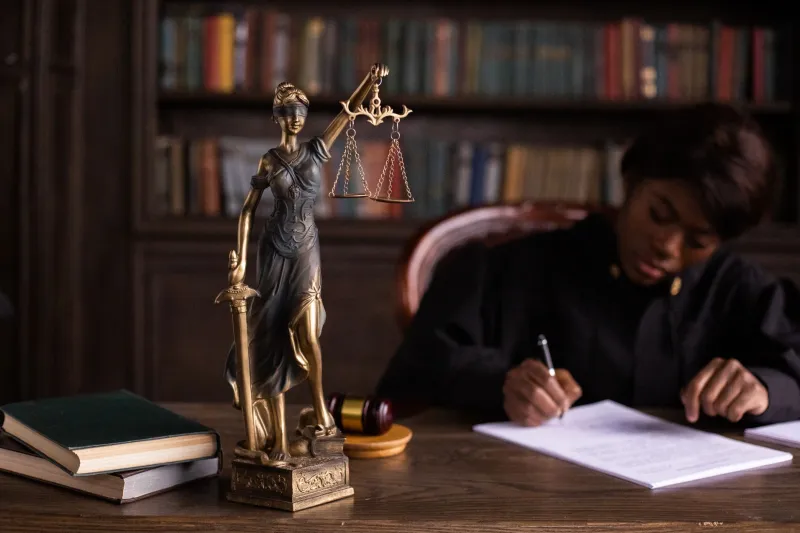
 Photo: Douglas County District Court, via ogdenimages.s3.amazonaws.com
Not metaphorically. Not as a thought experiment. An actual, paper-filed, docket-numbered lawsuit.
And here's the part that makes it truly bizarre: the court couldn't just laugh it off.
The Complaint, Formally Stated
Chambers was a 40-year veteran of the Nebraska Legislature, known for being the chamber's most outspoken gadfly and a relentless critic of what he considered frivolous litigation. The lawsuit was his protest against a bill moving through the legislature that would have limited the ability of citizens to sue over emotional distress. His argument, stripped to its core, was simple: if the courts are open to everyone, they're open to everyone.
So he sued God.
The complaint was meticulous. Chambers cited "fearsome floods, famine, pestilence, and other calamities" as damages caused by the defendant. He alleged that God had "made terroristic threats against the senator and his constituents." He requested a permanent injunction ordering the Almighty to stop causing natural disasters and other assorted catastrophes.
He filed it with a straight face. He kept that face for the duration.
The Court's Problem
Here's where it gets genuinely interesting from a legal standpoint. Douglas County District Court Judge Marlon Polk couldn't simply bin the lawsuit because it seemed ridiculous. American courts have a foundational obligation to consider any properly filed complaint. The question wasn't whether the case was absurd — it plainly was — but whether it met the legal threshold for dismissal under procedural rules.
That required Judge Polk to actually think through the legal mechanics of suing an omnipotent deity.
First problem: service of process. Before a lawsuit can proceed, the defendant must be formally notified. This is typically accomplished by handing documents to a person or their legal representative. God, as far as the court could determine, had no registered agent in Nebraska. Chambers argued this shouldn't matter — God is omniscient and therefore already aware of the lawsuit. The judge, impressively, engaged with this argument rather than dismissing it outright.
Second problem: standing. To sue someone, you need to demonstrate you've suffered a specific, concrete harm traceable to the defendant. Chambers' list of grievances — floods, earthquakes, pestilence — were real events, but establishing a direct causal chain between a named defendant and a natural disaster in a court of law is, to put it gently, complicated.
The Ruling Nobody Expected to Be This Thoughtful
Judge Polk dismissed the case in October 2008, but his written ruling was something unexpected: a careful, technically precise piece of legal reasoning that took the philosophical dimensions of the case seriously.
The core of the dismissal rested on the service of process issue. The court found that because God's "address" could not be determined and because there was no legally recognized representative to receive court documents, proper notification was impossible. Without proper notification, the case could not proceed — not because God was God, but because the defendant couldn't be reached through standard legal channels.
Polk's ruling also noted that the court lacked jurisdiction to enforce any injunction it might theoretically issue. An injunction only works if the subject of that injunction is bound by the court's authority. A being described in the complaint as omnipotent and existing outside human legal frameworks is, almost by definition, not subject to a Nebraska district court's enforcement powers.
What the judge carefully avoided doing was ruling on whether God exists. That question, the court noted, was outside its scope entirely. The dismissal was purely procedural. Which, if you think about it, is its own kind of philosophical statement.
Chambers Wasn't Done
After the dismissal, Chambers pointed out — correctly — that the ruling proved his original point. The court had just demonstrated that there are defendants a citizen cannot sue, regardless of grievance. If the courts were going to impose restrictions on emotional distress lawsuits for ordinary Nebraskans, they were creating a two-tiered system. His satirical lawsuit had generated a real legal precedent about the limits of judicial reach.
The legislature's bill, for what it's worth, did not pass in its original form.
Why This Story Refuses to Be Forgotten
What makes the Chambers lawsuit more than just a quirky footnote is what it accidentally produced. A state senator's act of legislative theater forced a sitting judge to write a genuine legal analysis of why a court cannot compel an omnipotent being to appear before it. That document exists in the public record. Law students have read it. Legal scholars have cited it in discussions about the boundaries of judicial authority.
The whole episode is a masterclass in how satire, when executed with enough technical precision, stops being satire and starts being something else entirely. Chambers didn't just make a joke. He made a legal argument disguised as a joke, and the system had to respond to it as a legal argument.
The lawsuit was absurd. The ruling was real. And somewhere in the gap between those two facts lives one of the strangest corners of American legal history.