One Bad Compass, Three Wrong Borders, and the Diplomatic Meltdown Nobody Saw Coming

He Was Just Supposed to Navigate Through the Jungle
Every military training exercise has a worst-case scenario baked into the planning. Twisted ankles, equipment failures, the occasional recruit who panics in the dark. What nobody thinks to plan for is the soldier who gets so completely, catastrophically lost that he accidentally invades a country.
That is more or less what happened in the spring of 1980, when a U.S. Army Reserve unit conducting a low-intensity navigation exercise in Central America produced one of the strangest diplomatic incidents the State Department had ever been asked to clean up — all because one man's compass was off and his map was out of date.
 Photo: State Department, via live.staticflickr.com
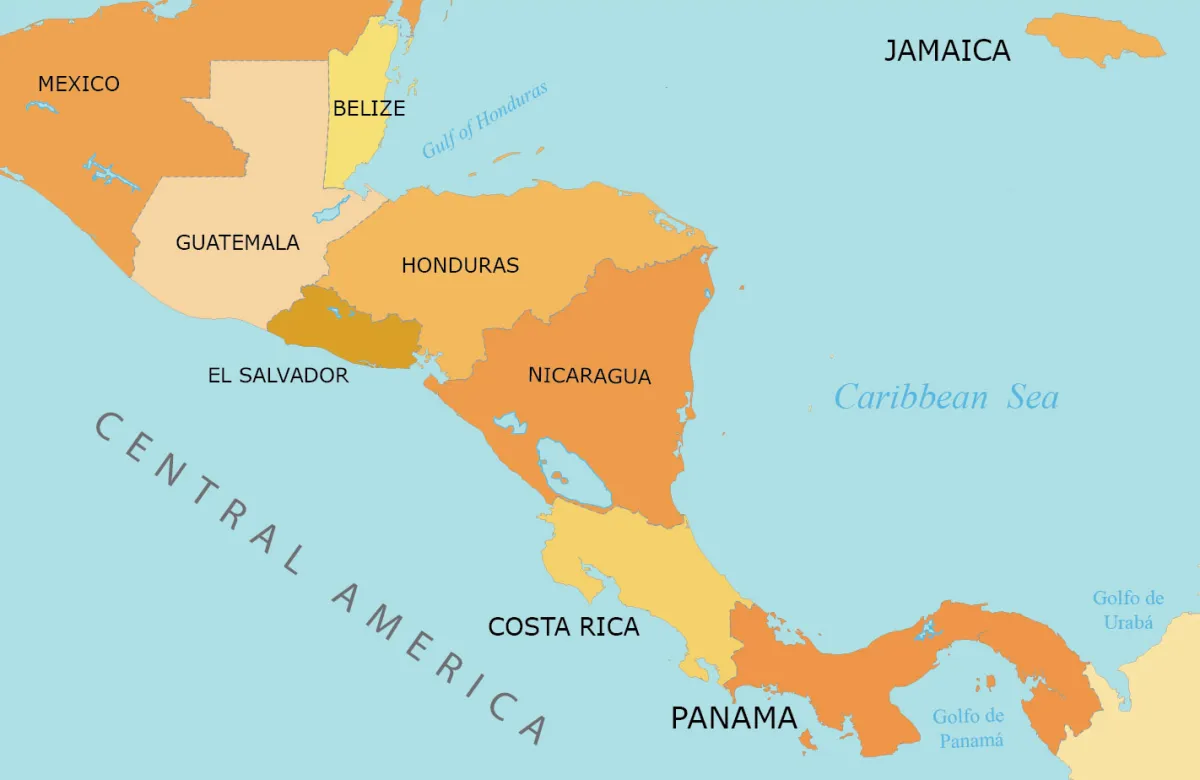 Photo: Central America, via gisgeography.com
The Exercise That Went Sideways Before Breakfast
The reservist in question — whose name was scrubbed from the public-facing diplomatic cables, though he was referred to internally as "Subject Alpha" in at least one State Department memo — was part of a small unit running a solo land navigation course through a stretch of dense lowland terrain near the tri-border region where three Central American countries meet at angles that even experienced cartographers find confusing.
The problem started with his compass. A manufacturing defect caused it to read consistently about 14 degrees off magnetic north — not enough to feel obviously wrong, but more than enough to send someone walking in a slow, confident arc away from where they were supposed to be going. Combined with a topographic map that hadn't been updated since the early 1970s and therefore didn't reflect a road rerouting that had shifted the visible landmarks, the reservist had essentially been handed a recipe for navigational disaster.
He walked for the better part of a day before he found a structure he could use as a reference point. That structure turned out to be a small unmanned customs checkpoint on the border of a country he was not supposed to be in.
"Occupied" Is a Strong Word, But the Paperwork Used It
Here is where the story gets genuinely strange. The customs station was not staffed that afternoon. The reservist, believing he had finally found a friendly waypoint on his own side of the border, entered the building, sat down, ate part of his field ration, and radioed his unit to report his position using the building's visible signage as a landmark.
His unit, realizing immediately that something had gone very wrong, attempted to quietly extract him. But in the time it took for a vehicle to reach the checkpoint, two local border officials arrived for their shift, found an armed American soldier sitting in their station eating crackers, and understandably escalated the situation with some urgency.
By the time the U.S. unit commander arrived to collect his reservist and offer what must have been an extraordinarily awkward apology, the incident had already been radioed up to the regional capital. Within 24 hours, it had reached three foreign ministries. By the end of the week, six embassies were involved.
The Diplomatic Untangling
What made the situation genuinely complicated — beyond the obvious awkwardness of an armed American being found alone in a foreign government facility — was the question of which borders had actually been crossed and in what order.
The tri-border region the reservist had wandered into was one of those geographic anomalies where the official boundary lines on paper don't match the terrain in any intuitive way. Depending on which country's maps you were using, the customs station either sat clearly inside one nation's territory or straddled a contested boundary with a second. A third country's foreign ministry inserted itself into the conversation on the grounds that the reservist may have briefly passed through a thin strip of their territory to get there.
This turned a simple extraction into a six-embassy negotiation over sovereignty, intent, and the precise definition of "occupation" under international law. U.S. officials were at pains to establish that the reservist had no orders, no mission objective, and no awareness that he had crossed any international line at all — which was entirely true and also somehow made the whole thing sound less believable, not more.
What a Broken Compass Actually Costs
The incident was eventually resolved without lasting damage to any of the diplomatic relationships involved, though it required formal written apologies to three governments, a quiet review of how the Army handled equipment inspection for reserve units, and at least one congressional staffer being asked to explain the situation to a very confused senator.
The reservist himself was never publicly identified, never charged, and by most accounts finished his reserve commitment without further incident. He had not acted with any hostile intent. He had not threatened anyone. He had eaten some crackers and waited for his ride.
But the episode became something of a teaching case inside certain corners of the military and the State Department, passed around as a reminder that international incidents don't require malice or even negligence. Sometimes all they require is a compass that's 14 degrees off and a map that's eight years out of date.
The Thin Line Between a Training Mishap and a Crisis
What makes this story stick is how little it took. No weapons were fired. No orders were disobeyed. No one made a decision that seemed unreasonable given what they knew at the time. A man followed his compass, found a building, and sat down to rest.
And six embassies spent two weeks sorting out the consequences.
The world's borders, it turns out, don't much care about your intentions. They care about where your feet are. And when your compass is broken and your map is wrong, those two things can diverge in ways that no training exercise — no matter how carefully planned — can fully prepare you for.